
TSMC Commits to Reach Net Zero Emissions by 2050, Acting on Responsibility to Environmental Sustainability
TSMC recently marked the International Day for the Preservation of the Ozone Layer with a commitment to reach net zero emissions by 2050. The Company also published its Task Force on Climate-related Financial Disclosures (TCFD) Report, becoming a semiconductor industry frontrunner in climate disclosure while taking actions towards the Company’s environmental sustainability goals. Read more +
As a responsible corporate citizen, TSMC strives to adapt to climate change and mitigate climate impact to protect our shared global environment. Guided by its ESG Policy and Environmental Policy, TSMC actively plans and implements actions to mitigate climate change, closely tracks a wide range of global climate action indicators, and is now taking a step further to create its roadmap to reach net zero emissions.
In 2018, TSMC published its Climate Change Statement, clearly stating that the Company addresses climate change through the two key measures of impact mitigation and risk adaption. At the same time, TSMC adopted the framework set by the Financial Stability Board's TCFD to identify risks and opportunities, as well as to set measurement benchmarks and manage targets. With an effective grasp of the progress and results of its actions taken on climate change, TSMC is able to lower the financial impact of climate risk on operations, and disclose results in the TSMC Corporate Social Responsibility Report.
To further address stakeholders’ concerns on climate change and focus on related issues, TSMC followed the TCFD framework and its spirit to publish the TCFD report in 2021, systematically disclosing management strategy and targets, ensuring sound execution and controls, and providing a comprehensive description of TSMC’s work and progress in responding to climate change.
“TSMC is deeply aware that climate change has a severe impact on the environment and humanity. As a world-leading semiconductor company, TSMC must shoulder its corporate responsibility to face the challenge of climate change,” said Dr. Mark Liu, Chairman of TSMC and Chairman of the Company’s ESG Steering Committee. “In addition to becoming the world’s first semiconductor company to join RE100, this year we have answered the call to action on net zero and published our TCFD report, aiming to broaden our green influence and drive the industry towards low-carbon sustainability.”
In 2020, TSMC established its Net Zero Project, composed of working groups from relevant organizations which discuss and evaluate the net zero target. In the same year, TSMC’s global offices achieved net zero emissions of greenhouse gases. To achieve its goal of net zero by 2050, TSMC will set related mitigation measures, continue to strengthen its wide variety of green innovations, and actively adopt renewable energy. The Company has set the short-term goals of zero emissions growth by 2025, and reducing emissions to year 2020 levels by 2030. TSMC will continue actively evaluating and investing in all types of opportunities to reduce carbon emissions.
For TSMC 2020 TCFD Report, please visit
https://esg.tsmc.com/download/csr/TSMC_TCFD_Report_E.pdf

TSMC 2020 Corporate Social Responsibility Report Now Available Online
To achieve the goal of sustainability, TSMC collaborates closely with its employees, shareholders and investors, customers, suppliers and contractors, and all other stakeholders. TSMC diligently fulfills its responsibilities for achieving sustainable development goals by working with upstream and downstream suppliers. The Company has adopted the CSR Report as an important tool for aligning with international standards and managing internal practices. The recently published "TSMC 2020 Corporate Social Responsibility Report" covers the Company's ESG performance and achievements over the past year, aligning with the United Nations (UN) Sustainable Development Goals. Read more +
 |
||
|---|---|---|
| Based on a foundation of healthy corporate governance, TSMC actively carries out our three missions of Acting with Integrity, Strengthening Environmental Protection, and Caring for the Disadvantaged. Starting from our core business, we set goals for execution, evaluate action plans, and maintain positive interactions with our stakeholders to continue creating value. - Dr. Mark Liu, Chairman and ESG Steering Committee Chairperson at TSMC |
||
| |
||
|---|---|---|
| Looking to the future, TSMC will stay true to our unwavering commitment to responsible operations and take tangible actions to support global sustainable development. - Lora Ho, Senior Vice President and ESG Committee Chairperson at TSMC |
||
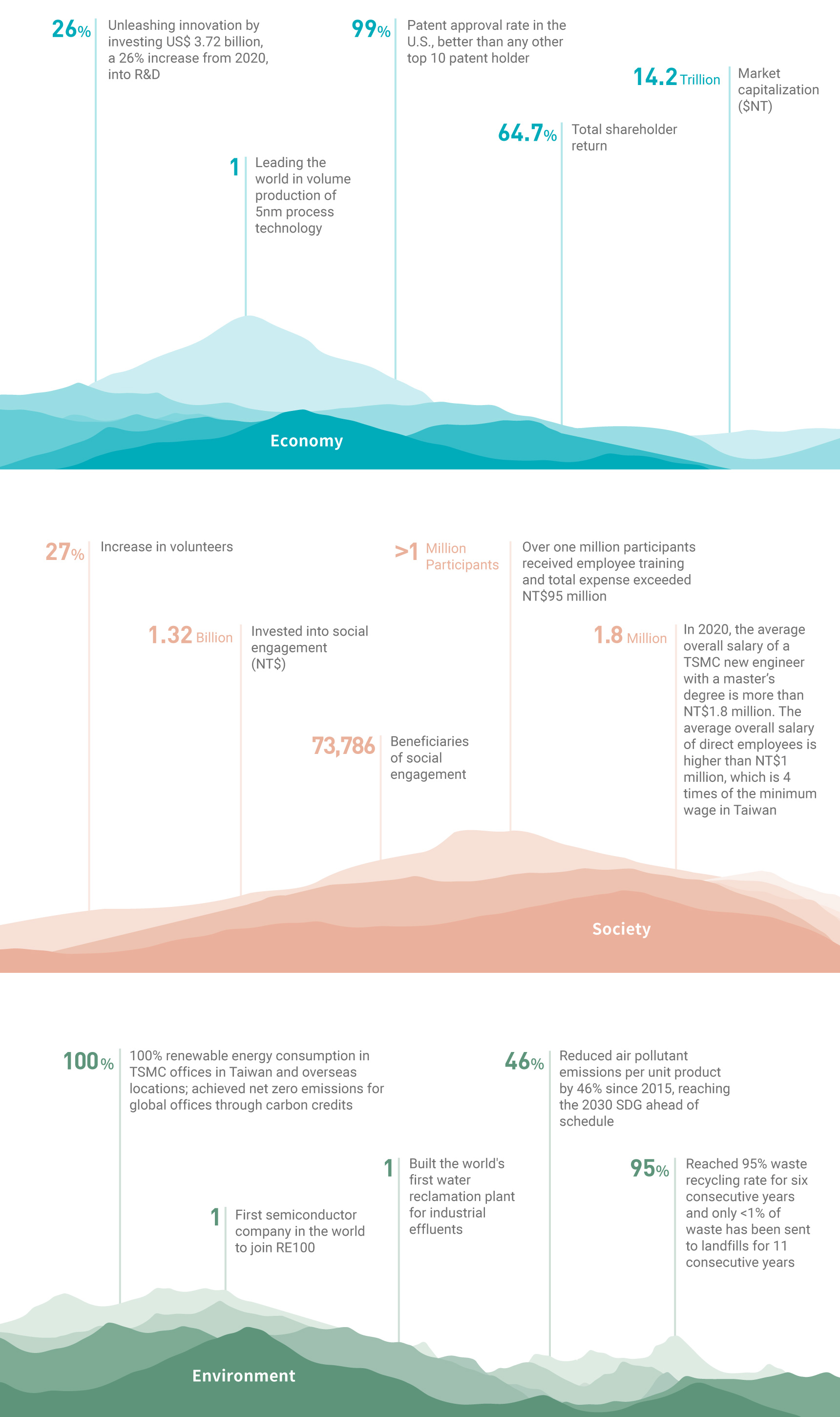
Beginning with the Company's core business, TSMC continues to strengthen its commitment to sustainable operations. TSMC's CSR achievements in 2020 were the results of long-term commitment and contribution from all its employees. With a dedication to “diligently doing everything right,” TSMC will never stray from pursuing sustainability and keep moving forward, and will partner with all relevant stakeholders and organizations to build a mountain of common good.
For more details about TSMC's sustainable actions, please refer to “TSMC 2020 Corporate Social Responsibility Report” and ESG website.

TSMC Enables Oticon to Bring Artificial Intelligence to Hearing Aids
TSMC is committed to driving positive changes with our technology and innovation, including enabling innovative hearing aid solutions to people affected by hearing loss or hearing impairment. Recently, our collaboration with a long-time partner Oticon has reached an important milestone with the launch of their newest hearing aid, featuring the first hearing aid chip with an embedded Deep Neural Network (DNN). TSMC's powerful and power-efficient technologies have been an integral part of Oticon’s ground-breaking hearing solutions, helping them to bring smart and connected products to adults and children all over the world. Read more +
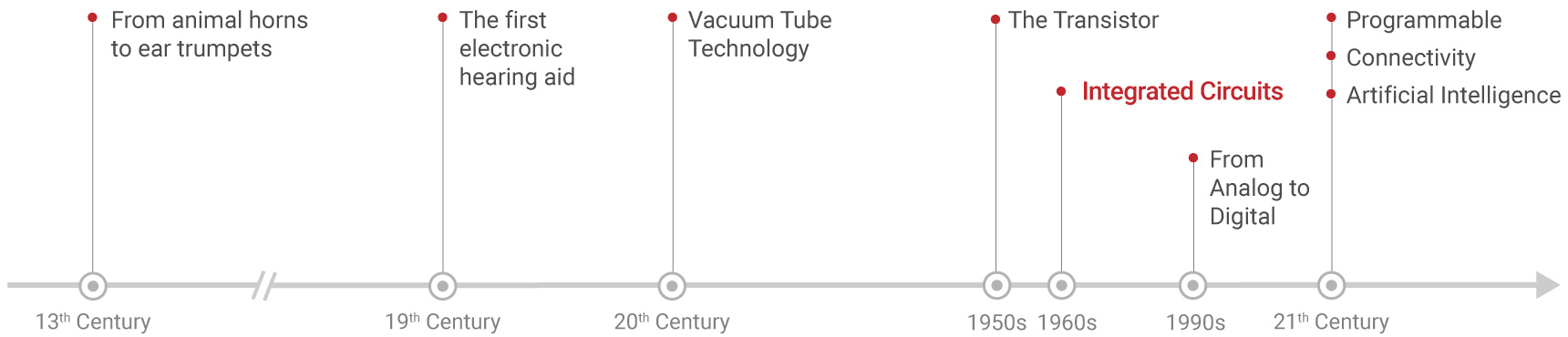
TSMC’s partnership with Oticon began in 2005, with a common belief in innovation and technology empowerment. Throughout our years of collaboration, TSMC has continued to support Oticon’s vision of creating a world where no one is limited by hearing loss. In the past 16 years, millions of Oticon hearing aids equipped with chips enabled by TSMC technologies have been sold worldwide. Our journey together on this road of hearing aid innovation is focused on the microscopic core of hearing aids – integrated circuits.
Major Milestones for Hearing Aids
Most devices nowadays contain three IC chips - DSP (Digital Signal Processor), Front End, and Radio – and they work in synergy to receive, convert, and process sound signals while at the same time enabling hearing aids to connect to other devices such as smartphones. The illustration below is a teardown of a hearing aid:

Image courtesy of Oticon
Advancements in semiconductor technology enable hearing aids to be powerful yet discreet, ultimately offering more freedom and mobility to wearers.
Traditional Hearing Aids vs. New Brain-friendly Hearing Aids
| Traditional Hearing Aids | Brain-friendly Hearing Aids | |
|---|---|---|
| Sound Source | Prioritize speech only | All meaningful sounds |
| Sound Quality | Compressed and restrictive | Preserve the natural quality of sound |
| Speech Understanding | Less and unclear | More and easier to follow |
| Overall Effect on Brain | Fatigue and overwhelmed | Reduced listening effort |
| Brain’s Capacity | Less capacity for memory and other cognitive processes | Increased cognitive functions |
In 2020, our long-standing partner Oticon took hearing solutions to another level with their latest offering, Oticon More™. The newest model is powered by TSMC’s 28nm low-power technology and contains 154 million transistors. Compared to the previous generation of Oticon Opn S™ which is powered by TSMC’s 65nm low-power technology and contains 64 million transistors, the newest model features one of the most advanced chips with AI sound processing and analysis capabilities. The migration to TSMC’s 28nm opened the door for Oticon to utilize DNN, which is trained with 12 million real-life sound scenes. This new feature allows hearing aids to mimic how the brain would hear sounds and aims to respond the same way as the brain. As more functions are added, more compute performance and improved power efficiency will be required to support future generations of hearing solutions. This collaboration between TSMC and Oticon is the epitome of how TSMC’s low-power technology continues to be an incredible apparatus for innovators.
TSMC’s Continual Support for Innovators’ Visions
TSMC technology has enabled leaders and innovators in audiology to move forward with infusing artificial intelligence (AI) into their most advanced hearing aids. Our low-power technology and manufacturing excellence continues to support innovators worldwide to offer increased capabilities without increasing the power budget. Driven by our mission to bring positive changes to society, TSMC will continue to work with leaders in hearing care technology to deliver hearing solutions that help people to live their lives to the fullest.
TSMC’s World-Leading High-Performance, Energy-Saving Semiconductor Technologies Help Customers Deliver More Energy-Efficient End Products
TSMC strives to fulfill its green commitment both in and outside the Company. Internally, TSMC makes continuous efforts to realize clean production in all fabs by implementing 460 energy-saving measures to conserve 500 GWh of electricity in 2020. Externally, the Company is developing world-leading high-performance, energy-saving semiconductor technologies to help its customers deliver energy-efficient products. Analytical results from Taiwan’s Industry, Science, and Technology International Strategy Center (ISTI) revealed that, in 2020, TSMC helped to conserve 4 kWh of energy for each 1 kWh spent in production worldwide, which is a testimony to TSMC’s commitment to green manufacturing. Read more +
Energy Consumption per Unit Product by TSMC Process Technologies

Note: The ratio of Logic IC/SRAM/ Input/output impacted die size and energy consumption but has been finetuned and corrected.
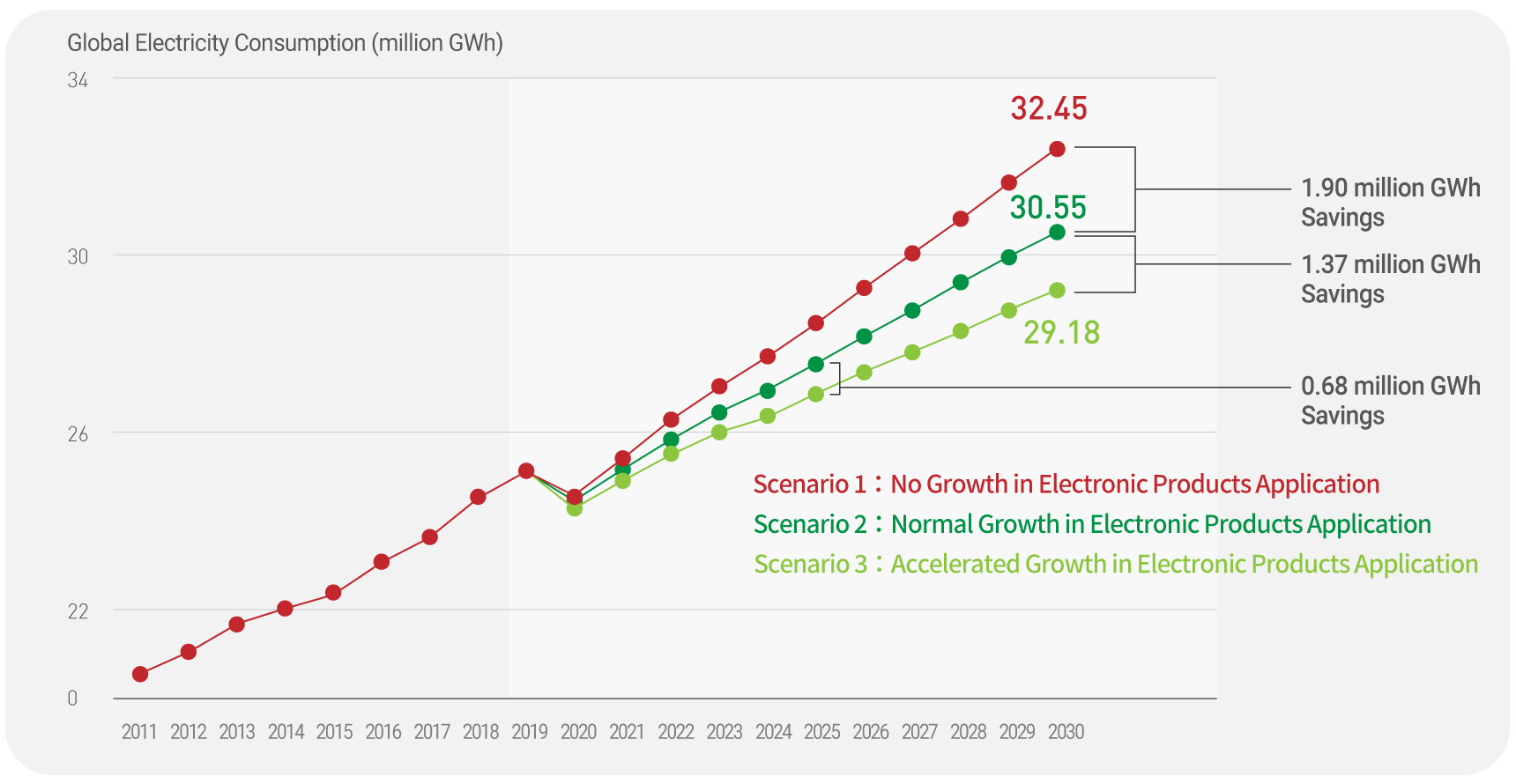
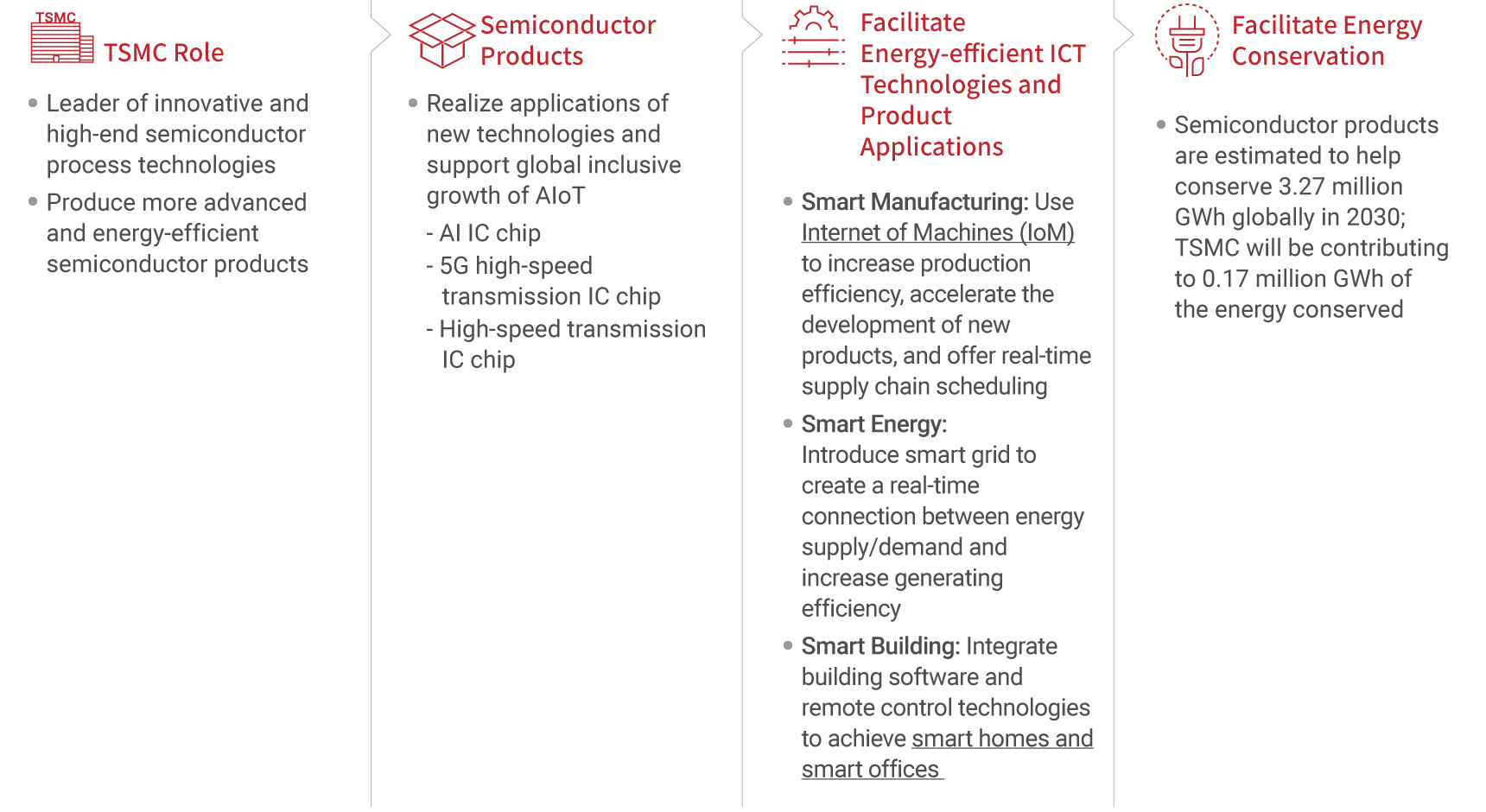
Referring to the research results from the American Council for an Energy-Efficient Economy (ACEEE), ISTI found that the link between economic growth and increasing energy consumption can be decoupled by the introduction of electronic products and smart product applications. The adoption of Information and Communications Technology (ICT) can also add value to industry productivity and generate greater output from the same amount of input including energy. Upon further analysis on electronic products using semiconductors as essential components, 10.7% of global energy (equivalent to 3.27 million GWh) can be conserved in 2030. Considering the ratio of semiconductors in electronic products and TSMC’s market share, the products that TSMC produces for its customers will conserve 0.17 million GWh in 2030, which is four times the energy consumed during production. With research and development to make products and processes more energy efficient, TSMC continues to make energy-efficient ICT applications and assist other industries and communities to achieve energy conservation.Global Energy Consumption Simulation
TSMC Contributions to Global Energy Conservation

TSMC Unveils Innovations at 2021 Online Technology Symposium
TSMC unveiled its latest innovations in advanced logic technology, specialty technologies, and TSMC 3DFabric™ advanced packaging and chip stacking technologies at the Company’s 2021 Technology Symposium on June 1. Taking place online for a second year, the symposium connects customers with TSMC’s new offerings, including N6RF for next-generation 5G smartphone and WiFi 6/6e performance, N5A for state-of-the-art automotive applications, and enhancements across the range of 3DFabric technologies. Over 5,000 customers and technology partners around the world have registered for our 2021 Technology Symposium, being held from June 1-2. Read more +
“Digitalization is transforming society faster than ever as people use technology to overcome the barriers created by the global pandemic to connect, collaborate, and solve problems,” said Dr. C.C. Wei, CEO of TSMC. “This digital transformation has opened up a new world full of opportunities for the semiconductor industry. Our global Technology Symposium highlights many of the ways we are enhancing and expanding our technology portfolio to unleash our customers’ innovations.”
Advanced Technology Leadership – N5, N4, N5A, and N3
TSMC was first in the industry to bring 5 nanometer (nm) technology into volume production in 2020 with defect density improving faster than the preceding 7nm generation. The N4 enhancement to the 5nm family further improves performance, power efficiency and transistor density along with the reduction of mask layers and close compatibility in design rules with N5. TSMC N4 development has proceeded smoothly since its announcement at the 2020 Technology Symposium, with risk production set for the third quarter of 2021.
TSMC is introducing N5A, the newest member of the 5nm family; the N5A process is aimed at satisfying the growing demand for computing power in newer and more intensive automotive applications such as AI-enabled driver assistance and the digitization of vehicle cockpits. N5A brings the same technology used in supercomputers today to vehicles, packing the performance, power efficiency, and logic density of N5 while meeting the stringent quality and reliability requirements of AEC-Q100 Grade 2 as well as other automotive safety and quality standards. TSMC N5A is supported by the flourishing TSMC automotive design enablement platform and scheduled to be available in third quarter of 2022.
TSMC’s N3 technology is poised to be the world’s most advanced foundry technology in both PPA and transistor technology when it is introduced. Relying on the proven FinFET transistor architecture for the best performance, power efficiency, and cost effectiveness, N3 will offer up to 15% speed gain or consume up to 30% less power than N5, and provide up to 70% logic density gain.
Advanced Radio Frequency Technology for the 5G Era – N6RF
5G smartphones require more silicon area and consume more power to deliver higher wireless data rates compared with 4G. 5G enabled chips integrate more functionality and components and are increasingly growing in size and competing against the battery for a limited amount of space inside the smartphone.
TSMC debuted the N6RF process, which brings the power, performance, and area benefits of its advanced N6 logic process to 5G radio frequency (RF) and WiFi 6/6e solutions. N6RF transistors achieve more than 16% higher performance over the prior generation of RF technology at 16nm.
Additionally, N6RF supports significant power and area reduction for 5G RF transceivers for both sub-6 gigahertz and millimeter wave spectrum bands without compromising performance, features and battery life offered to consumers. TSMC N6RF will also enhance WiFi 6/6e performance and power efficiency.
TSMC 3DFabric System Integration Solutions
TSMC continues to expand its comprehensive 3DFabric family of 3D silicon stacking and advanced packaging technologies.
| ● | For high-performance computing applications, TSMC will be offering larger reticle-size for both its InFO_oS and CoWoS® packaging solutions in 2021, enabling larger floor plans for chiplet and high-bandwidth memory integration. Additionally, the chip-on-wafer (CoW) version of TSMC-SoIC™ will be qualified on N7-on-N7 this year with production targeted for 2022 at a new fully-automated factory. |
|---|---|
| ● | For mobile applications, TSMC is introducing its InFO_B solution, designed to integrate a powerful mobile processor in a slim, compact package with enhanced performance and power efficiency and support mobile device makers’ DRAM stacking on the package. |