

A Practitioner of Green Power |
Green management is deeply ingrained in the daily operations of TSMC, and the Company continues to push forward with green fabs and green manufacturing. TSMC strengthens its green process capability through the four dimensions of energy management, water management, waste management, and air pollution control. The Company also shares its experience in sustainability, broadening its impact on society, and realizing the goal of an environment in harmony with technology.

To fulfills its commitment on green manufacturing and environmental protection through innovation and development, TSMC developed its industry’s first “optimal energy-saving control program” for its chilled water system in 2017. Furthermore, the Company pioneered the artificial intelligence (AI) in its energy saving system, using neural network algorithm of machine learning (ML) to build a low energy consumption model in 2018. Finally, TSMC successfully created its industry’s first AI powered chilled water control system that further increased energy efficiency by 2%, estimating 30 GWh of electricity to be saved every year.
The optimal energy-saving control program, which was developed with traditional prediction model in 2017, has greatly improved energy efficiency. However, problem occurs in the chilled water system after a long time of use, such as aging compressors and increased friction loss in pipelines. The old system won’t be able to precisely analyze or solve the problems caused by long time of use due to the limitation of its prediction model. It is also difficult to accurately predict a set of optimal temperature for energy consuming efficiency by engineer’s experience or using traditional engineering formulas in such high dimensional and complex nonlinear chilled water system.
In order to address those challenges and determine the optimal energy efficiency of the chilled water system, TSMC’s facility team used the massive amount of operational data, which was generated by an “optimal energy-saving control program,” to create a new model with neural network algorithm of machine learning. The new model has successfully determined 90 key parameters related to energy efficiency and electric consumption from over 1,000 related parameters of chilled water system.
To make good use of these 90 key parameters, facility team repeatedly explored the correlations between those 90 parameters, and evaluated their importance through 4.15 million data modeling trainings in 15 months. Therefore, the new model has successfully taken care of both efficiency problems of aging machine and nonlinear system complexity, and determined the best temperature for optimal energy efficiency with the new energy consumption prediction model in the new chilled water system. Compared with the old “optimal energy-saving control program” developed in 2017, the energy efficiency has increased 2% by the new system.
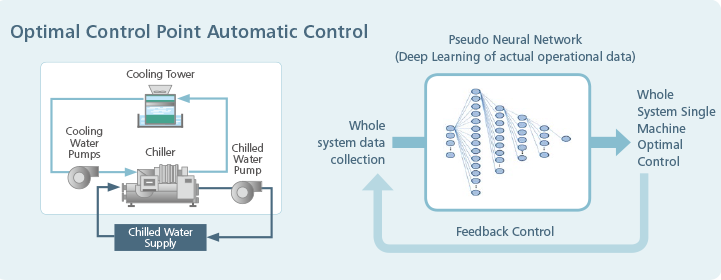 AI-ML Intelligent Engergy-Saving Chilled Water System

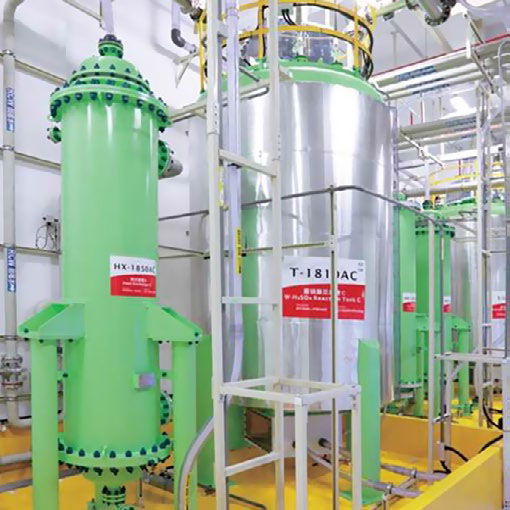 Sulfuric Acid Waste Recycling System
Adhering to its principle of "Minimizing Waste and Maximizing Resources," TSMC developed a pre-processing system for sulfuric acid and ammonia nitrogen wastewater in 2015, and in 2017 it was adopted by all TSMC fabs. Recycled sulfuric acid waste in fabs was used as adsorbents and combined with ammonia nitrogen wastewater, creating ammonium sulfate wastewater, which was then outsourced and used for other purposes. In 2018, TSMC further improved the ammonium sulfate crystallization system by introducing Mechanical Vapor Recompression (MVR) to create a more energy-efficient and effective way to convert ammonium sulfate wastewater into valuable industrial-grade ammonium sulfate products for resale. This is a successful case of combining used sulfuric acid waste with ammonia nitrogen wastewater into a valuable resource that can be reused. The outsourced disposal of sulfuric acid waste and ammonium sulfate wastewater decreased by 90,409 tons (eliminating the expense of purchasing the same amount of industrial-grade sulfuric acid) and 1,956 tons respectively, creating an estimated economic value of US$5.8 million (NT$180 million) per year, reducing outsourced disposal fees and sales fees for recycled resources.
TSMC 2018 Corporate Social Responsibility Report
TSMC conscientiously fulfills its corporate responsibilities and sustainability by collaborating with upstream and downstream suppliers, and has adopted the CSR Report as an important tool for aligning with international standards and managing internal sustainability. The Company has recently launched its 2018 Corporate Social Responsibility Report, which covers how TSMC continues to cultivate green manufacturing, create an inclusive workplace, care for the disadvantaged, and build a responsible supply chain to serve as a positive force in society. For the complete report, please click here.

| ● | A Hazardous Substance Process Management System. To fulfill the Company’s responsibilities in eco-friendly electronic products and environmental protection, TSMC built an IECQ QC 080000 hazardous substance process management system in compliance with the ISO 9001 framework. |
|---|---|
| ● | An Emergency Response and Crisis Management System for compound disaster. In 2019, TSMC will implement the emergency drills for compound disasters, increasing its crisis management capability and climate resilience, and reducing the impact of climate change. In 2020, TSMC will complete its enhancement of emergency response exercises, strengthen the command system, and complete training for emergency responders. |
| ● | Proprietary Information Protection Strengthen. Through long-term and continuous improvement activities such as training and promotion, annual PIP competitions, and PIP collaboration meetings with representatives of all organizations and overseas subsidiaries, TSMC secures confidential information to safeguard the interests of all stakeholders. |
| ● | Collaborative Robots to reduce ergonomic injuries at 6/8 inch wafer fabs. With the rapid development of industrial automation technology, TSMC’s 12-inch wafer manufacturing factories use Automatic Material Handling Systems (AMHS) to replace most of the manual wafer handling by employees. As a result, it significantly reduces ergonomic injuries caused by human factors due to repetitive handling of wafers. This year, the Company introduced collaborative robots to our 6-inch and 8-inch factories to reduce repetitive motion and take care of employee health. |
| ● | An Ergonomics Engineering E-System to build a safe workplace.
TSMC has adopted the Ergonomics Engineering E-System since 2013, and in 2018 the Company expanded the system to discover, analyze and eliminate dangerous factors, achieving the goal of preventing occupational injury and building a safe workplace.
For more information, please visit our CSR website at www.tsmc.com/csr/en/index.html |